
Waking Up to a Broken AC: Triage or Midnight Emergency?
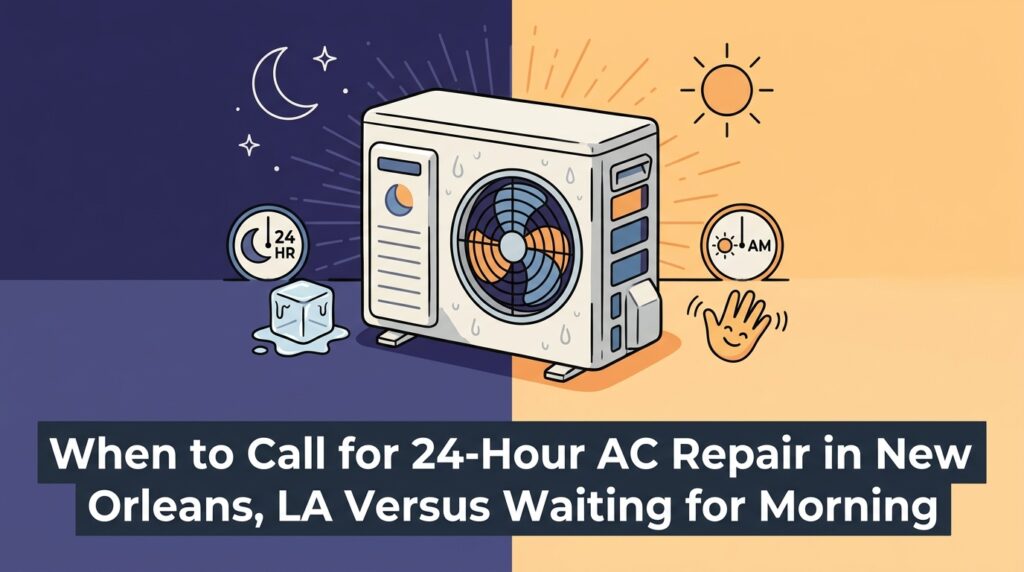
Are you staring at a blank thermostat at 2 AM, wondering if you need immediate help? Deciding When to Call for 24-Hour AC Repair in New Orleans Versus Waiting for Morning is a choice every homeowner in the Gulf South eventually faces. Waking up to a stifling, hot house creates instant stress, especially when the heavy New Orleans summer humidity begins seeping through the walls. You are suddenly forced to weigh the intense physical discomfort of the heat against the premium cost of an after-hours service dispatch.
If you are dealing with a critical system failure right now and need immediate HVAC services, you can safely call for 24-hour AC repair to get your home back to a safe temperature.
However, not every midnight malfunction requires immediate, premium-priced intervention. While a completely dead system feels like a disaster, many common air conditioning issues can be safely paused until normal business hours. The key is knowing how to accurately triage the symptoms your system is displaying. Making the wrong choice can mean either paying unnecessary emergency fees for a minor clogged filter, or worse, ignoring a serious electrical hazard that puts your property at risk. This guide provides a definitive, symptom-based checklist to help you evaluate your cooling equipment, protect your home, and make the smartest financial decision when your air conditioner stops working in the middle of the night.
Red Alert Symptoms: When to Dispatch a Technician Immediately
Certain air conditioning failures go beyond simple discomfort and cross the line into property damage or safety hazards. When you notice these red alert symptoms, waiting for the sun to come up is not a safe option. You need a professional to intervene immediately to prevent structural damage, electrical fires, or severe health risks.
If you observe any of the following issues, it is time to request HVAC emergency repair services without delay:
- Electrical burning smells or sparks: If you detect an acrid, plastic-like burning odor coming from your vents or the indoor air handler, shut the system down immediately. In our years of servicing homes across the local area, our team typically sees that this indicates melting wire insulation or a failing blower motor, which are leading causes of home structure fires.
- Total system failure with vulnerable individuals in the home: A broken air conditioner becomes a true medical emergency when the household includes elderly family members, infants, or individuals with respiratory conditions. The rapid rise in indoor temperatures can quickly lead to heat exhaustion.
- Rapid freezing of the evaporator coils with hissing noises: Ice building up on your indoor coils accompanied by a distinct hissing or bubbling sound points to a severe, active refrigerant leak. Continuing to run the system will destroy the compressor.
- Continuous tripping of the circuit breaker: If your air conditioner trips the breaker, you reset it, and it immediately trips again, stop. This is your electrical panel doing its job to prevent a catastrophic short circuit or overload.
We maintain our 24/7 emergency dispatch availability specifically as a safety net for these true critical failures, not as a tool to upsell panicked homeowners in the middle of the night. If you are experiencing these dangerous symptoms, scheduling a 24-hour AC repair New Orleans residents can trust is the only responsible next step.
Safe to Wait: AC Problems That Can Survive Until Morning
A transparent, triage-first approach means acknowledging that many air conditioning issues simply do not justify an after-hours dispatch fee. If your system is malfunctioning but not exhibiting any of the dangerous electrical or refrigerant symptoms listed above, you can likely protect your wallet and wait for standard business hours.
The most crucial step you must take in these scenarios is to safely shut the system off at the thermostat and the breaker. Forcing a struggling air conditioner to run all night will only cause further mechanical damage. By turning the power off, you preserve the equipment for the morning technician.
Here is a breakdown of common symptoms that are safe to defer until morning:
| System Symptom | Likely Cause | Immediate Action Required |
|---|---|---|
| Blowing slightly warm air | Dirty coils, low refrigerant, or a failing capacitor. | Turn the system off at the thermostat to prevent compressor burnout. |
| Minor airflow drops | A severely clogged air filter restricting the blower motor. | Check and replace the air filter. If airflow remains weak, leave the system off. |
| Thermostat communication errors | Dead thermostat batteries or a lost Wi-Fi connection. | Replace the batteries. If the screen remains blank, wait for a morning diagnostic. |
| Loud rattling or vibrating | Loose hardware, debris in the outdoor unit, or a worn fan belt. | Shut off the power to prevent the loose part from damaging internal components. |
Understanding what causes sudden AC system failures helps you stay calm when the house starts to warm up. If you are dealing with a non-hazardous mechanical issue, turning the unit off and setting up a few fans is the smartest way to handle the situation until the sun rises.

The Honest Reality of After-Hours Dispatch Fees
Making a decision at 2 AM requires a clear understanding of how after-hours service calls actually work. There is a fundamental difference between standard business hours dispatch and midnight emergency triage. During normal hours, technicians run optimized routes, moving efficiently from one neighborhood to the next. When you request a 24-hour AC repair New Orleans service call at 3 AM, a technician is being pulled from their home, often requiring overtime pay and dedicated travel logistics.
The cost-benefit analysis: This logistical reality is why after-hours dispatch fees carry a premium. Validating your desire to save money is important; no homeowner wants to pay an emergency rate if the situation is fundamentally safe. A reputable HVAC company prioritizes your financial well-being and physical safety over unnecessary midnight service calls. If the issue is a clogged drain line or a bad capacitor that isn’t causing an electrical hazard, paying a premium to have it fixed in the dark simply doesn’t make financial sense.
The importance of powering down: The single most effective way to save money during a midnight breakdown is to turn the system completely off. A pattern we see often in our local area service calls is homeowners leaving a malfunctioning system running, hoping it will magically start cooling again. Instead, this forces a compromised compressor to work against extreme friction or forces a frozen coil to expand, turning a simple, minor repair into a catastrophic, full compressor replacement. Turning the equipment off is the ultimate money-saving move.
How Local Climate Shifts the Emergency Threshold
The rules of HVAC triage change depending on where you live. In drier climates, opening a window at night might provide enough relief to sleep comfortably. In the Gulf South, the environmental realities drastically shift the emergency threshold. Based on our extensive experience serving the local area, we know that New Orleans summer humidity fundamentally changes how your body experiences a broken air conditioner.
Overnight temperatures in the region frequently struggle to drop below 80 degrees. When you combine that baseline heat with 80% or higher humidity, the indoor heat index rapidly climbs to dangerous levels. The human body relies on evaporating sweat to cool down, but high indoor humidity prevents this evaporation, leading to a stifling, oppressive environment. Furthermore, the ideal sleeping temperature for physical recovery is between 60 and 67 degrees. Without air conditioning, sleep quality plummets, leaving you exhausted and physically drained by morning.
If you evaluate your system and decide it is safe to wait until morning, you must implement short-term survival strategies to manage the indoor climate safely:
- Prioritize hydration immediately: Your body will lose significant moisture as the indoor temperature rises. Keep ice water at your bedside and drink frequently, even if you don’t feel excessively thirsty.
- Utilize strategic fan placement: Ceiling fans and oscillating floor fans do not lower the room’s temperature, but they do create a wind-chill effect on your skin. Position fans to blow directly across your bed to aid in sweat evaporation.
- Keep windows closed: It is a common mistake to open windows when the AC dies. Because the outside air is heavily saturated with moisture, opening windows will only invite more humidity into your home, making the heat index feel substantially worse. Keep the house sealed to trap whatever dry air remains.
- Relocate to the lowest level: Heat naturally rises. If you live in a multi-story home, move your sleeping arrangements to the ground floor, which will stay marginally cooler than the upper bedrooms.
Frequently Asked Questions About Midnight AC Failures
What is considered an AC emergency?
An AC emergency is any situation that poses an immediate threat to your property or your family’s health. This includes electrical hazards like burning smells or sparking, total system failure during extreme heat advisories, and severe refrigerant leaks that cause rapid coil freezing. If vulnerable individuals like infants or the elderly are in the home, a total loss of cooling during the summer is always considered an emergency.
Should I turn my AC off if it’s blowing warm air?
Yes, you should always shut the air conditioner off at the thermostat if it is blowing warm air. Continuing to run the system forces the compressor to work continuously without actually moving heat out of the house. This immense strain can quickly burn out the compressor motor, turning a minor repair into a major, expensive replacement.
Why does my AC smell like it’s burning?
A burning smell usually indicates a serious electrical or mechanical malfunction. You must differentiate between the brief, dusty odor of turning the system on for the first time in months, and an acrid, plastic-like electrical smell. An electrical burning odor means wire insulation is melting or a motor is overheating, requiring immediate shutoff and professional emergency intervention.
Is it safe to sleep in a house with no AC?
Whether it is safe to sleep without air conditioning depends entirely on the indoor heat index and the health of the occupants. For healthy adults, sleeping in a warm house is uncomfortable but generally safe if they stay hydrated and use fans for airflow. However, for the elderly, infants, or those with medical conditions, sleeping in a hot, highly humid environment can lead to dangerous heat exhaustion.
Should I turn off my AC if it is freezing up?
Absolutely. Continuing to run a frozen air conditioner will destroy the compressor by forcing liquid refrigerant back into the motor. You must turn the system off completely at the breaker so the thick layer of ice can begin to thaw. A technician cannot properly diagnose or repair a frozen unit until the ice has completely melted, which often takes several hours.
How quickly does indoor humidity rise when the AC breaks at night?
In humid climates, indoor humidity begins to rise within just an hour of the air conditioner failing. Your AC system acts as a massive dehumidifier, constantly pulling moisture out of the air. Once it stops running, the ambient moisture from outside begins to infiltrate the home, making the air feel sticky and pushing the indoor heat index higher than the actual thermostat reading.
Can running ceiling fans replace the need for an emergency AC repair?
Ceiling fans cannot replace an air conditioner because they do not remove heat or humidity from the room; they only circulate the existing air. While the breeze creates a wind-chill effect that makes you feel slightly cooler, the actual temperature of the room will continue to rise. Fans are a temporary comfort measure while you wait for a technician, not a permanent solution.
Make the Right Call for Your Comfort and Safety
Making the right choice at 2 AM is ultimately about balancing your family’s safety, your physical comfort, and your financial sense. By understanding the clear difference between a dangerous electrical malfunction and a minor mechanical hiccup, you can confidently decide whether to request immediate dispatch or power the system down until sunrise. Remember that forcing a broken system to run will only cause more damage, so when in doubt, turn it off at the breaker. Whether you determine you need an immediate midnight rescue or prefer to schedule a first-thing-in-the-morning appointment, expert help is always available. When you are ready to restore your home’s comfort, simply reach out and call for 24-hour AC repair to get your system diagnosed and repaired by professionals.